How to hang a picture: A guide to hanging frames & canvas prints
Tags
Interested in joining the world's leading print on demand platform?
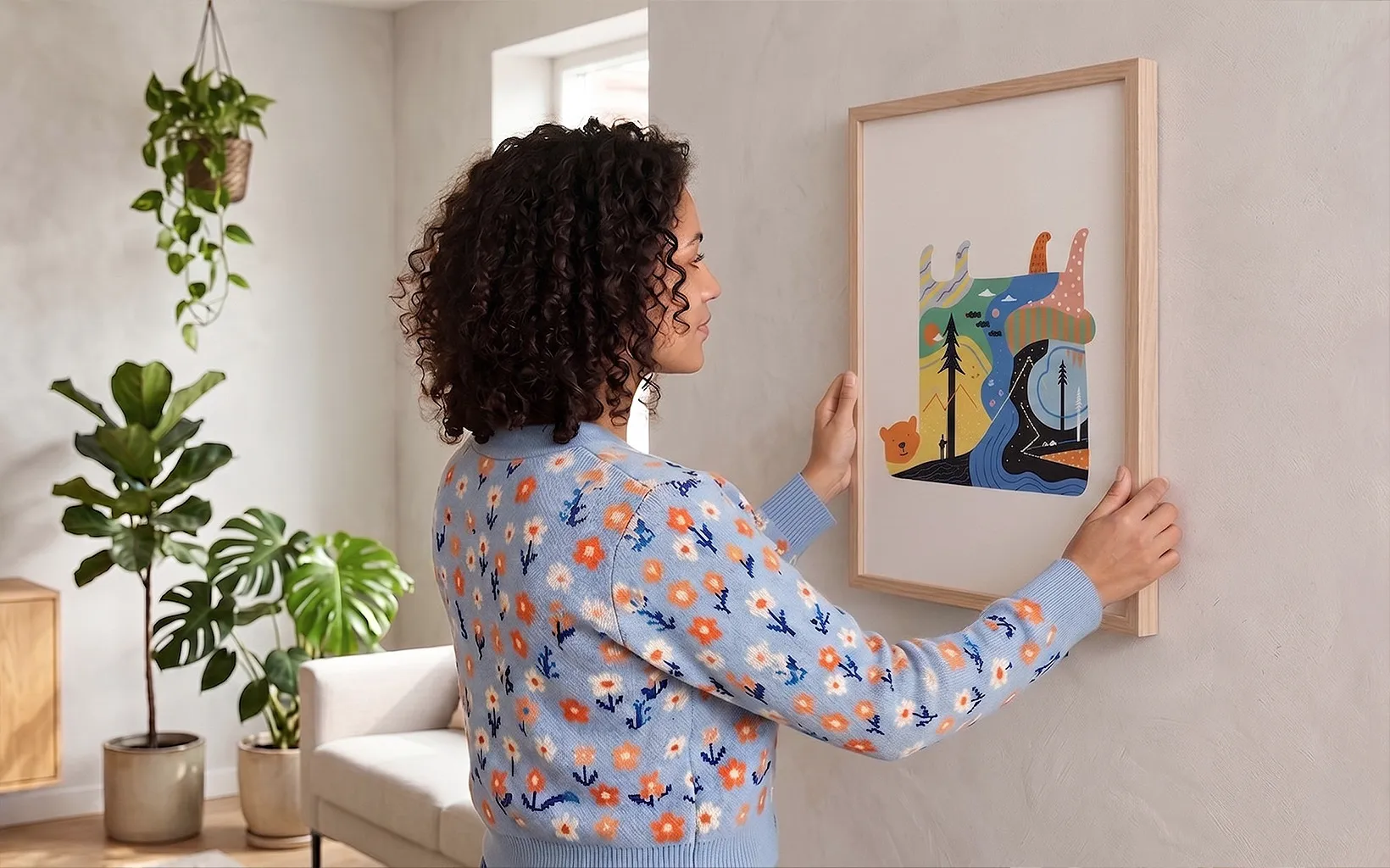
Hanging a picture sounds straightforward – until you’re standing on a step ladder with a hammer, wondering whether the hook is in the right place.
Whether you’re hanging a single framed print above a sofa or arranging a gallery wall across an entire staircase, a little preparation makes all the difference.
In this guide, we’ll walk through how to hang a picture frame, how to hang multiple pictures and how to hang a canvas print – including what hanging equipment comes with Prodigi’s wall art products so your customers know exactly what to expect before their order arrives.
What you’ll need
Before you start, gather the basics:
- a pencil
- a spirit level
- a tape measure
- a hammer, nails or screws, and picture hooks for frames
- wall anchors or Rawlplugs if you’re drilling into plaster or masonry
- painter’s tape (useful for planning gallery walls)
For heavier prints – extra large canvas art, acrylic panels or Dibond prints – you may also need a drill and appropriate fixings for your wall type.
How to hang a picture frame
Hanging a single picture frame
-
Choose the right location
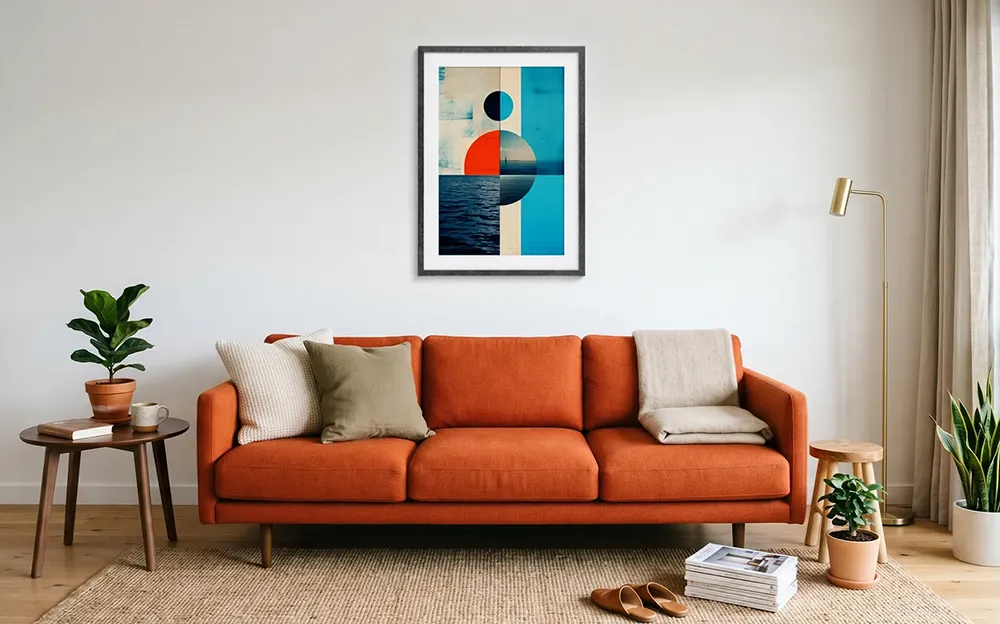
Before picking up a hammer, decide where the frame should go. Consider the size of the picture frame in relation to the wall – small frames can get lost in large spaces, while oversized frames may overwhelm a narrow section. For a balanced look, align the frame with nearby furniture, such as centring it above a sofa or console table.
-
Determine the correct height
A good rule of thumb is to align the top of the frame with the top of nearby doors or windows. This creates a natural visual consistency across the room. If there are no doors or windows nearby to reference, positioning the centre of the frame at eye level – around 150–160cm from the floor – is a reliable alternative.
-
Select the right hanging hardware
Choose fixings that are proportionate to both the frame’s weight and your wall type. Lightweight frames can usually be supported with a simple nail, but heavier pieces may require picture hooks or wall anchors for extra stability. If you’re hanging into a plasterboard wall rather than solid masonry, use cavity wall fixings to avoid the hook pulling free over time.
-
Measure and mark the hook position
The method here depends on the hanging hardware on your frame. For frames with a cobra or hinged sawtooth hanger, measure the distance from the top of the frame to the hanger, then mark this on the wall below your pencil mark – this is where your nail or hook should go.
For larger frames with a fixed sawtooth hanger along the top edge, the nail position simply needs to align with the height you’ve marked for the top of the frame.
If your frame has a hanging wire, pull it upwards to mimic how it will rest when hung, measure the distance from the top of the frame to the highest tension point of the wire, then mark this on the wall below your pencil mark.
-
Fix the hook and hang your frame
Attach the hook or nail at the point you’ve marked, angling nails slightly upward for extra stability. Smaller Prodigi frames come with a single cobra hanger, while medium frames come with two. Once secure, hang the frame and check it’s straight using a spirit level. Step back and adjust as needed.
Hanging multiple picture frames
-
Choose frames that work well together
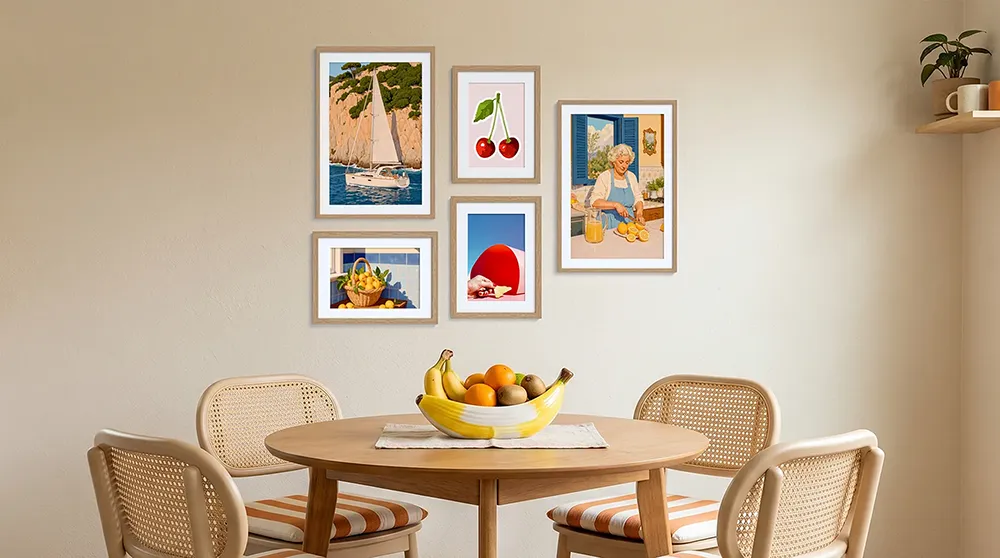
Select framed prints in a mix of styles and sizes that complement each other. Whether you go for matching frames or a varied mix, a shared colour palette or consistent theme helps the arrangement feel cohesive rather than cluttered.
-
Plan the layout before drilling
Cut paper templates to match the size of each frame and arrange them on the wall using painter’s tape. Experiment with different configurations until you find a layout that works. This step takes a few minutes but saves you from unnecessary holes in the wall.
-
Keep spacing consistent
A uniform gap – typically 5–8cm between each frame – helps maintain balance. Frames spaced too far apart can look disconnected; frames too close together can feel cramped.
-
Mark and fix each frame in turn
Once you’re happy with the arrangement, mark the hook positions for each frame using the same method as for a single frame. Fix all the hooks before hanging anything, then hang and level each frame in sequence.
How to hang a canvas print
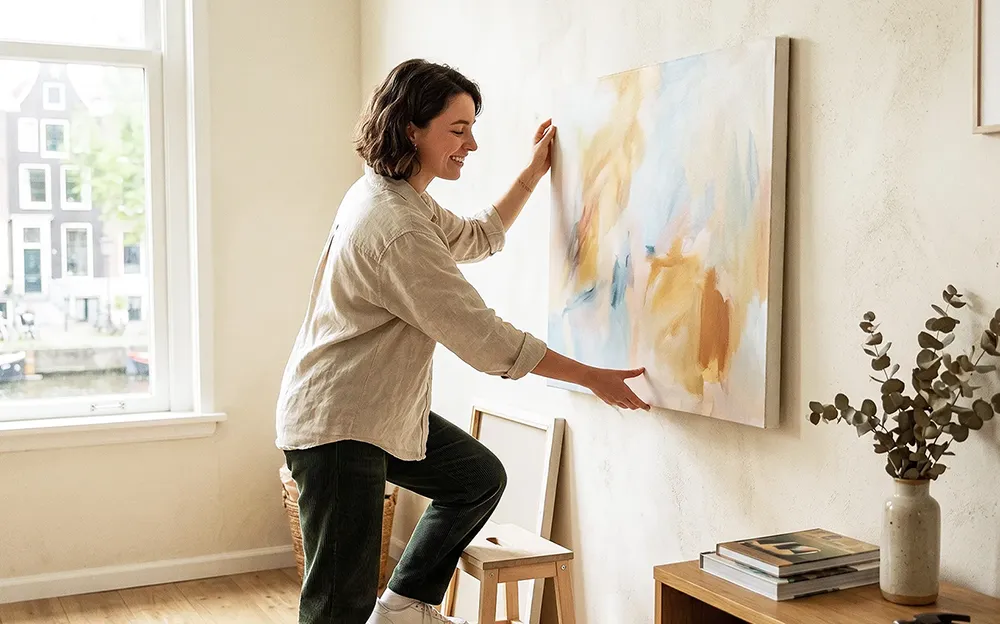
Knowing how to hang a picture frame is one thing – hanging a canvas print is slightly different, largely because of how they’re constructed. A stretched canvas has a wooden sub-frame, which affects both the weight distribution and how it sits against the wall.
-
Find the right spot
Canvas prints tend to work best in well-lit spaces where the texture of the print surface can be appreciated. Avoid hanging directly above a heat source such as a radiator, which can cause the canvas to warp or dry out over time.
-
Use the right fixing for the weight
Prodigi canvas prints don’t include hanging equipment – a nail or screw in the wall is all you need. For standard canvas sizes, a single nail or screw is usually sufficient. For very large or heavy canvases, use two nails or screws spaced across the width of the frame to distribute the load more evenly and prevent the canvas from tilting.
-
Hang level and check the back
Once hung, use a spirit level to confirm the canvas is straight. Because stretched canvases have a deep frame, even a slight tilt can be obvious. Check that the sub-frame sits flush against the wall to prevent the print from bowing outward at the edges.
Hanging equipment: what comes with Prodigi wall art products
Our wall art prints each come with different hanging systems depending on the format. Here’s what to expect:
Frames
| Product | Hardware included | How to hang |
|---|---|---|
| Classic frames | Cobra hook ≤70×100cm Sawtooth hanger above 70×100cm | Nail or screw |
| Spacer frames | Cobra hook ≤70×100cm Sawtooth hanger above 70×100cm | Nail or screw |
| Backloader frames | Cobra hook ≤70×100cm Sawtooth hanger above 70×100cm | Nail or screw |
| Budget frames | Cobra hook ≤70×100cm Sawtooth hanger above 70×100cm | Nail or screw |
| Instagram frames | Cobra hook ≤70×100cm Sawtooth hanger above 70×100cm | Nail or screw |
| Box frames | Cobra hook ≤70×100cm Sawtooth hanger above 70×100cm | Nail or screw |
| Aluminium frames | Built-in hanger | Nail or screw |
| Orders fulfilled via our Australian lab ship with wire regardless of size. | ||
Canvas prints
| Product | Hardware included | How to hang |
|---|---|---|
| Stretched canvas | None included | Nail or screw |
| Framed canvas | None included | Nail or screw |
| Orders fulfilled via our Australian lab ship with wire regardless of size. | ||
Other wall art
| Product | Hardware included | How to hang |
|---|---|---|
| Acrylic prints >8" | Sub-frame + hangman | Hangman system |
| Acrylic prints ≤8" | Sawtooth + bear claw | Nail or screw |
| Dibond prints | With subframe: sub-frame + sawtooth + bear claw Without hanger: none included | Nail or screw (with subframe) / your own fixing (without hanger) |
| Metal prints | Sub-frame + sawtooth + bear claw | Nail or screw |
| Gallery boards | Velcro dots | No drill needed |
| Photo tiles | Adhesive pads | No drill needed |
| Orders fulfilled via our Australian lab ship with wire regardless of size. | ||
Frequently asked questions
Do I need to drill into the wall to hang a picture?
Not always. For lightweight frames, a simple nail is usually sufficient. Adhesive picture hooks and Command strips are a practical no-drill option for smaller, lighter prints – particularly useful if you’re renting. For heavier pieces, a drilled fixing with a wall anchor will give a more secure result, especially on plasterboard walls.
What’s the correct height to hang a picture?
The simplest guide is to align the top of the frame with the top of nearby doors or windows for a natural, consistent look. If there’s no door or window to reference, positioning the centre of the frame at eye level – approximately 150–160cm from the floor – is a reliable alternative. In rooms where people are seated for much of the time, such as dining rooms, positioning artwork slightly lower can look more natural.
Can I hang a canvas print without a nail?
Yes. If you’re looking for how to hang a canvas without damaging the wall, Command strips and adhesive picture hooks are a practical option for lighter canvases, particularly if you’re renting. Always check the weight rating of any adhesive product before use – heavier canvases will need a more secure fixing.
How do I hang a picture without damaging the wall?
For small, lightweight prints, adhesive strips or removable hooks are a good option. For slightly heavier pieces, self-adhesive picture hooks that peel off cleanly can work well on painted plaster. For larger or heavier prints, a small nail hole is usually the most reliable option and is straightforward to fill and repaint if needed.
How do I hang multiple pictures in a straight line?
Use a spirit level and a long piece of string or a laser level to mark a consistent horizontal line across the wall. Then hang each picture so its centre aligns with this line, adjusting the hook height for each individual frame based on its hanging hardware.
How far apart should pictures be hung?
A gap of 5–8cm between frames is a common guide for gallery walls and multi-frame arrangements. The exact spacing depends on the size of the frames and the scale of the wall, but consistent spacing between all frames is what creates a cohesive, intentional look.
What hanging equipment comes with Prodigi prints?
Our canvas prints don’t include hanging equipment – they’re designed to hang flush against the wall directly on a nail or screw, and stringing them with wire would cause them to lean away from the wall. Picture frames and framed prints come with a variety of hanging hardware depending on the product. See the table above for a full breakdown.
Create & sell custom wall art with Prodigi
Prodigi is a global print on demand platform with in-house production facilities in the UK, US and Europe. Whether you’re printing a single canvas print for your home or building a catalogue of wall art products to sell online, orders are produced on demand and shipped direct to your customers – no minimum order quantities, no upfront costs.
Sign up for free and start selling immediately, or explore our full wall art range to see what’s possible.
Products in this article
Further reading
-

How to prep your artwork for custom foil printing
16 March 2023
-

How to create professional mockups for your print on demand products
23 October 2023
-
EU compliance for print on demand sellers: EPR, EUDR, GPSR & PPWR
14 August 2026
-

Create & sell print on demand colouring books with Prodigi
18 July 2025