Customer support at Prodigi: Human judgement, machine speed

Interested in joining the world's leading print on demand platform?
Written by Kate Farrell, Head of Operations at Prodigi
Good customer support should be simple. You have a problem, it gets fixed. In practice, most models make you choose between speed and quality: a bot that gives you an immediate answer but resolves nothing, or a human who can help but has 10 other customers to get to first. We don’t think that’s an acceptable trade-off.
Over the past couple of years, Prodigi has grown rapidly — more merchants, more products, more orders — and for a while, our support couldn’t keep pace. Rather than paper over the cracks, we decided to rebuild it from the ground up.
This article is a full account of how that model works, the principles behind it, the technology it runs on, and how we stack up against industry benchmarks. We’ll also share the data on what’s changed since we started rebuilding. It’s been a challenging process, but the early numbers are promising.
What we’re aiming for
Good support gets you the right answer, quickly, the first time. That sounds obvious, but it rarely plays out that way, because most support functions are built around the provider’s costs rather than the customer’s problem. Cheapest-to-serve wins, and the customer adapts. We’ve built ours the other way round — around what our merchants have told us they want, even where that’s harder or more expensive for us.
When the answer already exists in our systems, customers want it straight away, and they don’t care whether it’s a human or a machine that fetches it. When the answer requires judgement, they want to speak to someone who understands the situation and its nuances, not a bot sending them in circles. Whatever the issue, they want to know a human is always available if they need one. So that’s what we’ve built for: fast, automated answers when the facts are there, and a real person for everything else.
How we think about AI
The temptation with AI is to hand it everything. Some companies have done exactly that, putting a chatbot in front of every customer and stepping back entirely. It rarely works, and many have quietly reversed course.
Not long ago, one of our merchants forwarded us an automated reply they’d had from another print provider. It told them the company no longer accepted email enquiries and that the message had been closed, before signing off, without a trace of irony, with “here 24/7 to assist you” — an auto-response that shuts the door and calls it service.
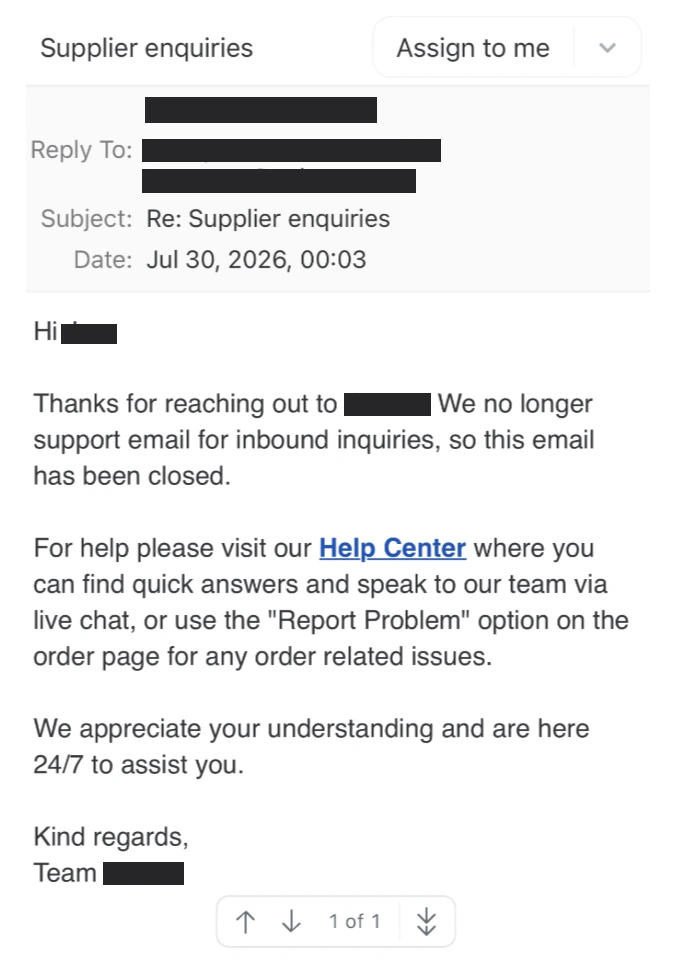
That’s not our idea of good support — a “solution” that saves the company time and leaves the customer with nowhere to go.
Our thinking is simple, and it cuts both ways. There are jobs an AI does better than any person: reading a message instantaneously, pulling an order history without missing a single detail, checking a shipping status at three in the morning, never tiring of being asked the same question for the thousandth time. And there are jobs no AI should be trusted with: reading a customer’s mood and responding to frustration with genuine empathy, using discretion on a goodwill gesture, untangling a problem nobody has seen before. Most support models pretend one is the other. Ours doesn’t.
We’ve intentionally split the work, so our people spend less time on routine queries and more time where they’re genuinely needed. When a person picks up your ticket, it’s because the situation calls for one. If you’re dealing with our AI, we’ll tell you, plainly, every time. And if you’d rather speak to a person, they’ll never be more than one click away.
Who does what
AI handles
- Instant answers from your data
- An order’s full history, every field
- Status checks at 3am, 24/7
- Drafting and triage groundwork
- The thousandth identical question
People handle
- Judgement on a tricky call
- Empathy when it matters
- Discretion on goodwill
- Problems no one has seen before
- The relationship behind the ticket
The technology behind it
A single print on demand order hides a surprising amount of complexity behind the scenes. It can pass through design files and colour profiles, a print lab, a finishing and quality check, packing, a courier, and a payment flow — often spread across different companies and time zones — before it reaches your customer. Given how many of those steps could go wrong, what’s striking is how seldom they do. We don’t say that to wave away the times something slips, but because every one of those handoffs is a point where we’re quietly joining the dots on your behalf. Doing that well — and putting it right quickly when it goes wrong — is the mark of good customer support.
The hardest part is getting the right information in front of the right person quickly enough to matter. For a long time that information lived in separate places, and a good chunk of the team’s time was simply tracking it down before they could even start to help. We’ve changed that in two ways.
First, we built a single data layer. Order, production, shipping, billing, and account information now flow into one live picture that runs from the production floor outward. When something happens to an order anywhere in our network, that picture updates — so whoever picks up your query can see the whole story in one place, at any hour, wherever in the world they happen to be. No more chasing context across half a dozen systems before anyone can help.
Second, we built an intelligence layer that works alongside our team, not instead of it. When a query comes in, it reads the message, works out the issue type and how urgent it is, pulls the relevant facts from the data layer, and does the groundwork before a person takes over: a suggested reply, the right context, and a clear flag on what needs attention first. It never replies to you on its own. Its whole job is to make the person who does reply faster, better informed, and more consistent.
Instead of creating the underlying AI from scratch, we’ve built our own layer on top of best-in-class tools that understand our products, our brands, and the awkward edge cases that only show up at our scale. That understanding is where the real value sits, and combined with our joined-up data, it’s what off-the-shelf tooling on its own simply can’t give you.
Getting the basics right mattered just as much as the clever bits on top. Before any of this, we pulled documentation that had been scattered across multiple drives into a single knowledge base, tidied up our response templates, and cleared out more than a hundred old automations that had quietly built up over the years. It’s not glamorous work, but it’s why things now behave the way they should.
Behind every reply
The data layer
One live view of every order: production, shipping, billing and account data, brought together and always on.
The intelligence layer
Reads each query, pulls the facts, drafts a reply and flags what matters first. It never replies to you on its own.
Our people
Judgement, empathy and the final reply, faster and better informed because the groundwork is already done.
Our guiding principles
Every decision we make about our customer support is shaped by the following principles:
- Solved first time. A fast reply that fixes nothing isn’t support. Closing a ticket twice is closing it once, badly.
- Speed and substance. Machines handle instant lookups, while humans offer judgement, empathy, and nuance.
- No dead ends. A human is always reachable. Bots gather and prepare — they don’t gatekeep.
- People over profits. When doing what’s cheapest for us would mean a worse outcome for you, we’ll always put you first.
- Solutions, not workarounds. A refund or credit is a tool, not a resolution. We use it where it’s right, but the instinct is always to fix what went wrong.
- No surprises. Stockouts, production hold-ups, shipping delays — we’ll let you know before you have to ask.
How a ticket moves through Prodigi
Most of what follows is live today, and the newest part is just arriving. We’ve replaced our old support bot with a new tool, built from the ground up based on our guiding principles. By the time you read this, it will be available for you to try. It won’t be perfect straight away, but we’ll keep improving it in the open, and your feedback will directly shape what it becomes.
Here’s how it works. A merchant raises an issue through structured intake — not an open-ended chat box, but a guided path that identifies the problem, narrows to the specifics, and gathers all the necessary information before anything else happens. It works this way to get you to the right answer faster, not to keep you at arm’s length. From there, one of three things happens:
- If the answer lives in our systems — such as an order status, a shipping update, or payment history — you get it on the spot, 24/7.
- If the answer requires human judgement — such as investigating a damaged print, an order stuck in production, or an integration that’s misbehaving. We gather the full context and send it to the right specialist through one of our defined channels. Whoever picks it up already has the whole picture. No being asked the same question by three different people or tickets disappearing into a general inbox.
- If you’d rather speak to a person — that option is always there. We won’t keep you in a loop of bots when what you want is to talk to a human.
The people behind the platform
None of this works without people, and we’ve invested heavily in them. Our support team spans the UK, the Netherlands, and a wider global network — which is what makes round-the-clock human coverage real, rather than a promise that only holds in one time zone. Between them, they look after 11 brands and handle around 7,000 queries in a normal month, climbing upwards of 13,000 at the December peak.
At the core of that team is our Head of Customer Support, who’s been with Prodigi long enough to know its edge cases, exceptions, and undocumented quirks inside out. The most important change we’ve made is to her role. She now spends her time building a team as capable as she is, turning deep, hard-won knowledge into something the whole team shares.
We’ve hired deliberately around her. A Customer Support Specialist now owns the integration, API, and platform queries that used to cause bottlenecks, acting as the bridge between merchants and our engineers so those questions get expert answers quickly. A Senior Support Advisor in our Amsterdam office anchors our European-hours coverage, with more hiring under way. And a trained, multi-brand support team provides the volume cover and the overnight hours.
Getting here wasn’t easy
The rebuild was a response to a real problem. As Prodigi grew, our support became overwhelmed. Beneath the capacity gap was a quality gap: tickets closed without the underlying issue fixed, generic answers given where specific ones were needed, expertise that lived in people’s heads rather than in systems.
The numbers told the story. Our first response time sat at around 26 hours in early 2026 — more than a full working day. For a perishable problem, a day of silence is costly to a merchant’s business. We’re including that figure rather than burying it, because the recovery only means something measured against it. Rebuilding the data layer, the intelligence layer, the knowledge base, and the routing was the direct response.
What good looks like & how we measure up
Here’s the part most companies leave out: an honest look at how we stack up against the wider world, and the targets we’re working towards. The model is sound, but we’re still partway through putting it into practice.
| Metric | Industry average | Best-in-class | Prodigi now | Our target |
|---|---|---|---|---|
| First response time | ~12–17h | <1–4h | ~8h, falling | <8h same-day, then <6h |
| Resolution time | ~82h | ~17h (top 5%) | ~19h, falling | hold + improve |
| Handling time | ~6 min | ~2–3 min | 6 min (was 11) | hold + improve |
| One-touch resolution | ~70% | 80%+ | ~66% | lift with new assistant |
First response time
On first response time, the cross-industry average for email and tickets is roughly 12 hours, based on SuperOffice’s benchmark of around 1,000 companies. In retail and ecommerce, our corner of the world, it runs higher still, closer to 17.
Ours has almost halved this year — from roughly 26 hours in January, down to around 8 hours in July — already quicker than the retail and ecommerce average, and still falling. We’re not going to call it best-in-class, because the very fastest teams reply within the hour, but it’s a real, sustained improvement. The standard we’re holding ourselves to is a same-day reply every time, which for us means keeping consistently under eight hours, with under six the next goal.
Resolution time
Our resolution time — how long it takes to close an issue — has come down sharply this year. The typical order is now resolved in around 19 hours, down from around 37 in January. To put that in context, a widely cited study of 1,000 companies found the average support ticket takes more than 80 hours to resolve, with only the fastest teams getting under about 17. So our typical resolution now sits right at the front of the pack.
We’re not done, and we’re working to bring it down further.
Handling time
Handling time — the active time we spend answering a ticket — has dropped from 11 minutes to 6, marking a 45% fall.
That time doesn’t disappear. It goes back into the tickets that actually need a human, so our team can spend longer on the problems that genuinely call for judgement. The aim is to hold that gain and keep improving.
Driven by AI-assisted recommended responses and macro selection.
Source: Prodigi CS dashboard, 2026. (Peecho fell from 6 to 2 minutes over the same period.)
One-touch resolution
One-touch resolution is the share of queries we settle in a single reply, with no back-and-forth. It sits at around 66% today — just shy of the 70% a well-run team averages, and some way off the 80%+ the very best reach. We don’t expect it to climb much further on its own, and that’s the point. It’s exactly the measure our new support assistant is built to lift, by making sure that when a query reaches a person, they already have everything they need to resolve it in one go.
The impact so far
Put simply, the rebuild is working. The metrics that were in trouble are now moving firmly in the right direction, and the model we set out to build is doing what we hoped it would — but the real test is still to come.
That test is one-touch resolution: the truest measure of whether we’re fixing things properly, first time. It’s the number we’ll be watching most closely over the coming months.
We think this is the best way to run support today — “today” being the key word. How we divide the work between machines and people will keep evolving, and we’ll keep adapting alongside it. As the technology moves on, so will we.
In short
Prodigi customer support rests on a single idea: you shouldn’t have to choose between machine speed and human judgement. Fetching data is a job for a machine; exercising judgement is a job for a human. The data feeds both from one live view, and you decide where the line falls. There’s still ground to make up, but the initial figures are encouraging, and the benchmarks show just how much further we intend to go.
Got a question or want to share your feedback? Get in touch by emailing support@prodigi.com.
Further reading
-
Create orders & product mockups in one place with our new mockup tool
16 February 2024
-

What does NFT mean? Non-fungible tokens, explained
17 November 2021
-

Print on demand for artists: what's the best approach for selling your work online?
19 January 2021
-

Introductory guide to PPC advertising for custom merchandise
28 May 2021